The sand in the Corralejo dunes is ground-up marine shell, not Saharan dust blown across the water. There is no gate, no ticket and no closing time, so you can walk in off the FV-1 at any hour. What you cannot do is take a vehicle onto that sand, which is the one thing most people arrive hoping for.
The dunes on foot
Parque Natural de Corralejo is a protected park, not a national park, and the rule that matters is short. No vehicle of any kind may leave the road, and walkers are asked to stay on the marked paths. Access is along the FV-1, where roadside bays stand in for a car park, and the ones nearest Flag Beach go first. Coaches and minibuses pull into the same bays.

Walking in from the centre of Corralejo takes an hour and a half to two hours. The line 6 bus between Corralejo and Puerto del Rosario stops at the dunes, and the full run costs €3.40. At the southern end, the 314 m cone of Montaña Roja is a straightforward walk up with views in every direction. There is almost no shade anywhere in the park, so carry water and cover up.
Grandes Playas and Playa del Moro
Grandes Playas runs for about 10 kilometres along the eastern edge of the park, and it is really several named beaches in a row. The northern ones have beach bars, toilets and showers, and you can hire a sunbed and parasol at the Bajo Negro section (€€). Low dry-stone windbreaks called zuccos sit along the back of the sand, and the ones toward the southern end are used by nudists.

The water has strong currents and rip tides, and lifeguard cover is patchy. The open fetch suits windsurfers and kitesurfers. For a swim with small children, the currents here are the wrong kind.
Playa del Moro sits in the middle of the park and is sheltered from northerly winds, which is why the surf schools work from it in the mornings. Nothing is sold on the beach, so bring food, water and your own shade. You can drive in from Corralejo or Parque Holandés and park directly behind the sand.

The volcanoes and Lajares
Volcán Bayuyo stands just inland of Corralejo and has two craters of almost equal size. A vehicle track reaches the base, and from there the crater is about 10 minutes on foot. The high points look over Corralejo, the dunes, Isla de Lobos and across the channel to Lanzarote. Barbary ground squirrels come right up to walkers. You can also walk the whole thing as a loop from town. That is 12 to 15 km and takes three and a half to four and a half hours. There is no shade at all on the cinder slopes.

The better walk is Volcán Calderón Hondo, a 4.6 km loop from Lajares that takes most people one and a half to two and a half hours. It is flat and easy until a short steep finish on rock-cut steps, and the crater only shows itself from the rim. There is no fee and no permit, and you park near the start of the trail. If a scramble up steps is beyond you, leave this one out.

Lajares is where you eat on a northern loop. Surf, kite and craft shops line the main street, which you can walk end to end. The craft market runs on Saturday mornings from 10:00 to 14:00. Los Pinchitos in the village cooks goat, and Canela Café holds an open jam session every Wednesday.

Majanicho and the popcorn beach
Majanicho is about 15 minutes from Corralejo, either on the paved road down from Lajares or along the coastal dirt track. A few small fishing boats sit in the cove, with stone fish-cleaning tables on the shingle beside the houses. There are no shops and nowhere to eat, so carry what you need from Corralejo or Lajares.

The same track takes you to Playa del Bajo de la Burra, known as Popcorn Beach for the knobbly white nodules covering the shore. They are rhodoliths, calcareous algae that grow underwater at about a millimetre a year, so a palm-sized piece can be centuries old. Breaking them up or taking any away is an offence, and shells, stones and sand are seized at the airport. The beach is small and the approach is rough, so skip it in a low hire car.

Buggies and quads from Corralejo
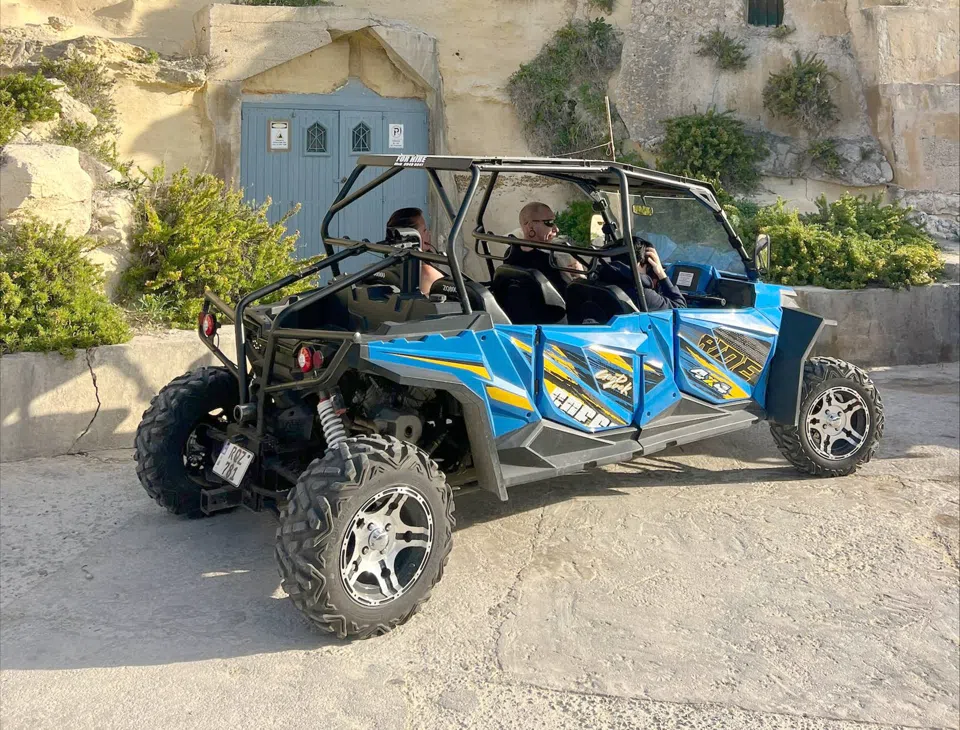
Every motorised tour treats the dunes the same way. It stops at them. Corralejo Buggies drives paved road to the park for a photo stop and a 15-minute walk. It then picks up the dirt track at Villaverde for about 45 minutes of volcanic paths. There is a drink stop near Parque Holandés. The loop covers close to 42 km and takes two to two and a half hours. It costs €62 to €139 per person, depending on how many of you share a buggy. Departures are at 09:00, 12:00 and 15:00, with pick-ups from Corralejo, El Cotillo, Origo Mare and Caleta. The buggies are automatic and no off-road experience is needed, but the driver has to produce an original physical category B licence.

Dune Buggy Fuerteventura works from a kiosk on Avenida Juan Carlos I, a short walk from the main strip. Its two-hour tours meet at 08:15, 11:15 and 14:15, and the fleet includes four-seat buggies, so two adults with children can ride in one vehicle. There is no pick-up from the south of the island.
For a quad instead of a roll cage, Que Guapo Tour runs from C. Bajo del Mejillón. Riders go two to a tandem quad and the price is €140 per quad. The two-hour route is mostly off-road on the tracks north of the FV-1 and stops at Bayuyo, Calderón Hondo and Majanicho. You get dust and sun for the full two hours. All of these run seven days a week, so pick the departure that fits your day and book ahead.

El Cotillo lagoons and lighthouse
Playa de la Concha y Los Lagos in El Cotillo is where you swim. La Concha is a cove held behind a dark lava reef. It has showers, toilets, accessible access and lifeguard cover, and it is about 10 minutes' walk from the northern village bus stop. Los Lagos, just north of it, is a chain of natural lagoons with no facilities on the sand and the village a few minutes away. The harbour restaurants serve the day's fish, the rooms are small, and the little places prefer cash, so book in high season and at weekends and bring notes.
Faro del Tostón y Museo de la Pesca Tradicional stands on a flat black headland north of El Cotillo. It is about half an hour from Corralejo, on the FV-101 and FV-10 through Lajares. Three towers from 1897, 1955 and 1986 share the site, and there is parking. Below them are reef-protected lagoons shallow enough for families. The fishing museum in the middle building opens only intermittently, so go for the headland and treat the exhibits as a bonus.

Isla de Lobos permits
Landing on Isla de Lobos needs a free authorisation from lobospass.com, one for every person, children included. Visits come in two four-hour slots, 10:00 to 14:00 or 14:00 to 18:00, and places are released only a few days ahead, so book as soon as they open. Ferries leave Corralejo harbour all year and take 15 to 20 minutes, and a round trip is €17.50. Some tickets include the authorisation and some do not, so check which one you are buying.

The circular trail is 12 to 13 km and takes three to four hours with stops. It passes the lagoon at Las Lagunitas and goes up La Caldera, which is 127 m high. There is no shade and no drinking water on the route, and nobody stays overnight. Without a permit in hand you cannot land, although boat trips that circle the islet without stopping need no paperwork.
Early starts and quiet afternoons
Do the walks first thing. Neither Calderón Hondo nor Bayuyo has any shade, so early morning or the hour before sunset are the windows that work. The roadside bays along the FV-1 fill through the middle of the day, and at weekends in high season they fill sooner. Playa del Moro is quietest in the afternoon, once the surf schools have packed up their boards. For the El Cotillo lagoons, aim for mid to high tide, because at low tide they largely drain.
Days and bookings
The park and its beaches never close, so there are only two fixed points in your week. The buggy office in Corralejo is open Sunday to Friday from 10:00 to 17:00 and shut on Saturday. The Lobos permit has to be in hand days before you sail.
See the Fuerteventura guide and the Fuerteventura hotel search.